- Microfluidic Molecular Communications
Molecular communication (MC) provides a way for nano/microdevices to communicate information over distance via chemical signals in nanometer to micrometer scale environments. The successful realization of MC will allow its future main applications, including drug delivery and environmental monitoring. The main hindrance for the MC application stands in the lack of nano/micro-devices capable of processing the time-varying chemical concentration signals in the biochemical environment. One promising solution is to design and implement programmable digital and analog building blocks, as they are fundamental building blocks for the signal processing at MC transceivers. This project aims to design the chemical reaction-based microfluidic MC prototypes with time-varying chemical signal processing functionalities, including modulation and demodulation, encoding and decoding, emission and detection. This also facilitates the microfluidic drug delivery prototype design and cancer cell on chip testing under time-varying drug concentration signal.
[1] V. Walter, D. Bi, A. S. Reyhani, Y. Deng*, “Real-Time Signal Processing via Chemical Reactions for a Microfluidic Molecular Communication System,” in Nature Communications, 2023. [PDF] [VIDEO][CODE]
[2] D. Bi, Y. Deng*, “Microfluidic QCSK Transmitter and Receiver Design for Molecular Communication,” in IEEE Trans. on Communications, 2022. [PDF]
[3] D. Bi, A. Apostolos, A. Noel, Y. Deng*, R. Schober, “A Survey of Molecular Communication in Cell Biology: Establishing a New Hierarchy for Interdisciplinary Applications,” in IEEE Communications Surveys and Tutorials, 2021. [PDF]
[4] D. Bi, Y. Deng*, “Digital Signal Processing for Molecular Communication via Chemical Reactions-based Microfluidic Circuits,” in IEEE Communications Magazine, 2021. [PDF]
[5] Y. Deng, M. Pierobon, A. Nallanathan, “A Microfluidic Feed Forward Loop Pulse Generator for Molecular Communication,” in Proc. of IEEE GLOBECOM’17, Singapore, Dec. 2017. (Best Paper Award (15/2600 submissions) ) [PDF]
[6] D. Bi, Y. Deng*, M. Pierobon, A. Nallanathan, “Chemical Reactions-based Microfluidic Transmitter and Receiver Design for Molecular Communications ” in IEEE Trans. on Communications, vol. 68, no. 9, pp. 5590-5605, Sept. 2020. [PDF]
- Goal-oriented Semantic Communications
Inspired by Shannon’s classic information theory, Weaver and Shannon proposed a more general definition of a communication system involving three different levels of problems, namely, (i) transmission of bits (the technical problem); (ii) semantic exchange of transmitted bits (the semantic problem); and (iii) effect of semantic information exchange (the effectiveness problem). The first level of communication, which is the transmission of bits, has been well studied and realized in conventional communication systems based on Shannon’s bit-oriented technical framework. However, with the massive deployment of emerging devices, including Extended Reality (XR) and Unmanned Aerial Vehicles (UAVs), diverse tasks with stringent requirements pose critical challenges to traditional bit-oriented communications, which are already approaching the Shannon physical capacity limit. This imposes the Sixth Generation (6G) network towards a communication paradigm shift to semantic level and effectiveness level by exploiting the context of data and its importance to the task and the goal of communications. My research will focus on goal-oriented and semantic communication solutions for diverse data types, including image data, video data, extended reality data, C&C data for mobile robotic and robotic arms in the digital twin.
[2] S. Chen, E. S. Papastavridis, Y. Jin, and Y. Deng*, “Goal-oriented Semantic Communication for Robotic Arm Reconstruction in Digital Twin”, in IEEE Journal on Selected Areas in Communications, 2025. [PDF] [VIDEO]
[3] W. Wu, Y. Wu, Y. Yang, and Y. Deng*, “Goal-oriented UAV Communication Design and Optimization for Target Tracking: A Machine Learning Approach”, in IEEE Communications Letters, 2024. [PDF]
[4] W. Wu, Y. Yang, Y. Deng*, and A. H. Hamid, “Goal-oriented Semantic Communications for Robotic Waypoint Transmission: the Value and Age of Information Approach”, in IEEE Trans. on Wireless Communications, 2024. [PDF]
[5] H. Zhou, Y. Deng*, X. Liu, N. Pappas, and A. Nallanathan, ” Goal-oriented Semantic Communications for 6G Networks”, IEEE Internet of Things Magazine, 2024. [PDF]
- Cellular-connected UAVs Systems in 5G and Beyond
The 5G-and-Beyond cellular networks promise UAVs with ultra-reliable low-latency control, ubiquitous coverage, and seamless swarm connectivity under complex and highly flexible multi-UAV behaviours in three-dimension (3D), which will unlock the full potential of UAVs. This so-called cellular-connected UAVs (C-UAVs) system creates a radically different and rapidly evolving networking and control environment compared to conventional terrestrial networks. This project aims to develop artificial intelligence (AI)-powered for C-UAVs system with full network automation and conditional control automation, that allow for joint design and optimization of the network operation and the UAVs control in real-time with minimum human supervision and the target of mission completion under the long-term quality of service (QoS) guarantees.
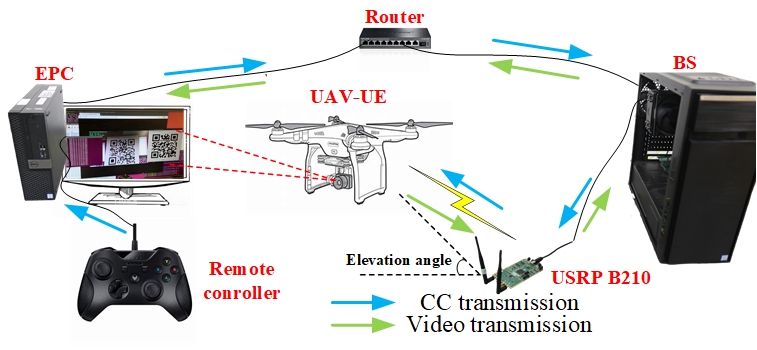
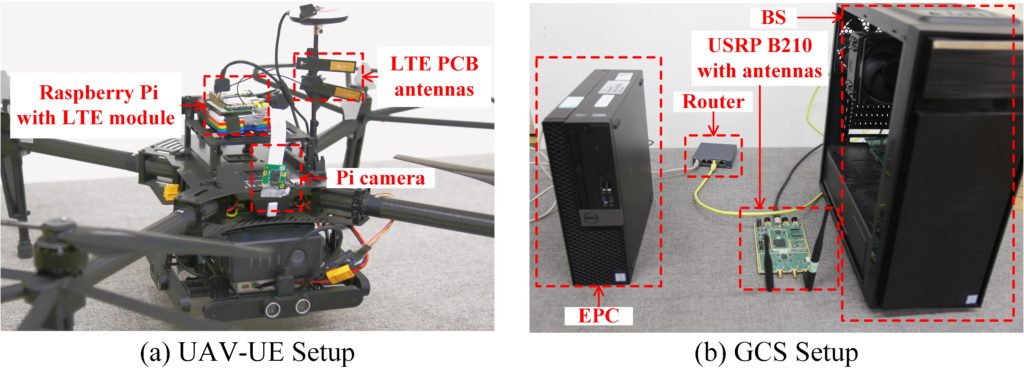
[1] H. Zhou, F. Hu, M. Juras, A. B. Mehta and Y. Deng, “Real-time Video Streaming and Control of Cellular-Connected UAV System: Prototype and Performance Evaluation,” in IEEE Wireless Communications Letters, 2021. [PDF]
[2] Y. Su, H. Zhou, Y. Deng*, and M. Dohler, ” Energy Efficient Cellular-Connected UAV Swarm Control Optimization”, in IEEE Trans. on Wireless Communications, 2023. [PDF]
[3] Y. Xu, H. Zhou, and Y. Deng*, “Task-Oriented Semantics-Aware Communication for Wireless UAV Control and Command Transmission”, in IEEE Communications Letter, 2023. [PDF]
[4] J. Hou, Y. Deng, M Shikh-Bahaei, “Joint Beamforming, User Association, and Height Control for Cellular-Enabled UAV Communications”, IEEE Trans. on Communications, 2020. [PDF]
[5] D. Fan, F. Gao, B. Ai, G. Wang, Z. Zhong, Y. Deng, and A. Nallanathan, “Channel Estimation and Self-Positioning for UAV Swarm”, IEEE Trans. on Communications, 2019. [PDF]